


Top 5 Lithium Battery Companies Revolutionizing Global Energy Storage
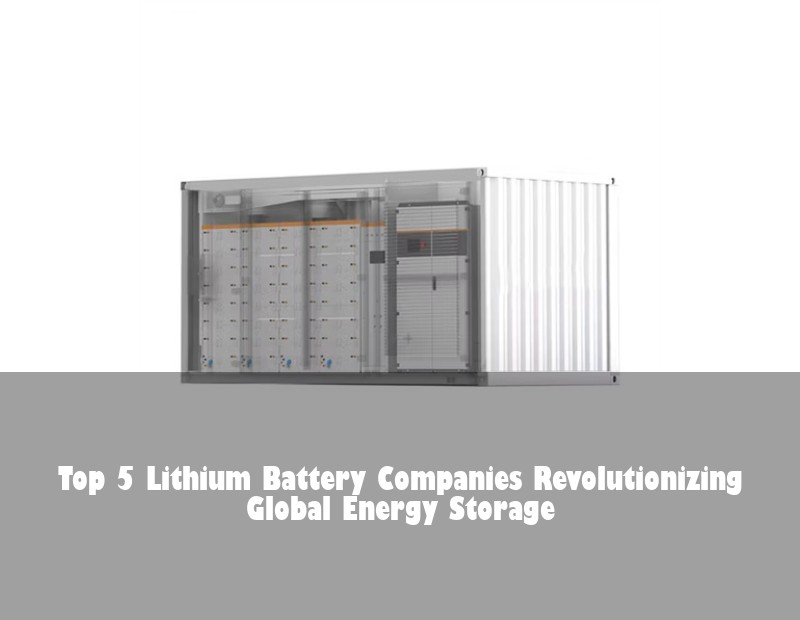
Table of Contents
The Lithium Battery Demand Surge
Ever noticed how Europe's energy landscape is transforming before our eyes? Solar panels glint from rooftops in Berlin, wind turbines spin across Spanish plains, yet there's an invisible hero making this renewable revolution possible: lithium batteries. These compact powerhouses solve renewable energy's Achilles' heel – intermittency. Consider this: Europe's grid-scale battery storage capacity is projected to grow 15-fold by 2030, with lithium-ion technology capturing 90% of this market. Why the frenzy? As German energy analyst Klaus Müller puts it: "Without advanced storage, our green transition remains half-built." The market isn't just growing – it's evolving toward smarter, safer, and more sustainable solutions.
How We Ranked the Top Performers
Selecting industry leaders isn't about popularity contests. We evaluated companies through a multi-lens approach focusing on:
- Innovation Index: Patents filed and R&D investment ratios
- European Footprint: Manufacturing facilities and local partnerships
- Sustainability Metrics: Closed-loop recycling rates and carbon-neutral commitments
- Real-World Performance: Field data from grid-scale installations
This rigorous framework ensures we spotlight truly transformative players, not just the loudest marketers. After all, when your home or business relies on energy storage, compromise isn't an option.
Top 5 Lithium Battery Companies
1. CATL (Contemporary Amperex Technology)
Imagine powering 1.3 million electric vehicles annually from a single facility. That's CATL's Ningde "gigafactory" reality. The Chinese giant dominates with 34% global market share and recently unveiled condensed battery technology achieving 500Wh/kg density. Their European anchor? A €1.8 billion plant in Thuringia, Germany, supplying BMW and Mercedes. What sets them apart? Proprietary cell-to-pack technology eliminating 40% of structural components while boosting thermal stability.
2. LG Energy Solution
When Sweden's largest solar farm needed storage for its 65MW output, they chose LG's RESU units. Why? LG's nickel-manganese-cobalt (NMC) batteries deliver industry-leading 6,000+ lifecycles at 90% depth of discharge. Their Poland facility – Europe's largest lithium battery plant – produces 700,000 cells daily. LG's secret sauce? AI-driven battery management systems that predict cell degradation within 2% accuracy, extending lifespan by up to 30%.
3. BYD
BYD's Blade Battery isn't just a product – it's a safety revolution. Passing nail penetration tests without combustion (a industry benchmark for thermal runaway prevention), these LFP batteries power 40% of London's electric buses. Their Hungarian factory focuses on ESS products tailored to European voltage standards. Impressively, BYD achieves 98% metal recovery in their closed-loop recycling process – a critical advantage under EU battery regulations.
4. Panasonic
Remember Tesla's million-mile battery promise? Panasonic made it real. Their 4680 cylindrical cells (developed with Tesla) achieve 16% higher range than previous models while reducing cobalt content to 5%. In Europe, they're pioneering a virtual power plant project in Portugal linking 10,000 home batteries into a 55MWh grid buffer. Panasonic's edge? Decades of consumer electronics precision applied to energy storage.
5. Northvolt
This Swedish startup embodies European battery ambitions. Founded by ex-Tesla executives, their "Revolt" recycling program recovers 95% of battery metals – crucial for EU circular economy goals. Their gigafactory in Skellefteå runs on 100% hydropower, producing cells with 90% lower CO2 footprint than Asian imports. Volkswagen and BMW have invested €6.5 billion collectively, betting on localised, sustainable supply chains.
| Company | Energy Density (Wh/kg) | Cycle Life | European Production (GWh/yr) |
|---|---|---|---|
| CATL | 285-500 | 8,000 | 14 (Germany) |
| LG Energy | 270-320 | 6,000+ | 65 (Poland) |
| BYD | 180-230 | 12,000+ | 20 (Hungary) |
| Panasonic | 260-380 | 5,500 | N/A (Japan import) |
| Northvolt | 220-250 | 7,000 | 60 (Sweden) |
European Market Case Study: Germany's Grid Balancing Act
Let's examine a real-world stress test. During January 2023's "dunkelflaute" (dark doldrums) – when Germany experienced 10 consecutive days of near-zero wind and solar generation – grid operators faced a critical challenge. Enter LEAG's 53MWh battery storage facility in Lübbenau, powered by CATL and LG cells. This installation:
- Delivered 42 hours of continuous grid support during peak demand
- Prevented €1.2 million in fossil-fuel balancing costs
- Responded to frequency drops in under 100 milliseconds
 Image source: Pexels - Professional photography of energy storage facility
The project demonstrates how lithium batteries transition from backup solutions to active grid assets. With Germany targeting 200GWh of storage by 2030, such installations become blueprints for pan-European energy resilience.
Future Trends: Where Battery Tech Is Heading
While today's leaders dominate, tomorrow's landscape will shift. Three innovations deserve your attention:
Solid-State Breakthroughs
Toyota's prototype solid-state batteries (targeting 2027 production) promise 750Wh/kg density – potentially doubling EV range. The elimination of liquid electrolytes addresses safety concerns that haunt current systems.
Sodium-Ion Economics
CATL's sodium-ion batteries entered mass production in 2023, costing 30% less than lithium equivalents. Though energy density lags at 160Wh/kg, they're ideal for stationary storage where space isn't constrained.
Second-Life Ecosystems
Nissan and Renault lead in repurposing EV batteries into home storage units. A 40kWh EV battery retains ~70% capacity after vehicle use – perfect for solar load-shifting. This circular approach could reduce system costs by 40% while delaying recycling.
Your Energy Storage Journey
Choosing the right battery partner isn't about chasing specs – it's about aligning technology with your unique energy profile. Ask yourself:
- Is your priority peak shaving for commercial savings or off-grid resilience?
- How does your local climate impact battery performance and degradation?
- What regulatory incentives exist in your region for storage integration?
As you evaluate options, consider this: Which energy storage innovation will most dramatically reshape your relationship with power in the coming decade? The answer might just redefine your energy independence.
 Inquiry
 Online Chat