


Telecom Battery: How Much Does It Cost and Why It Matters?
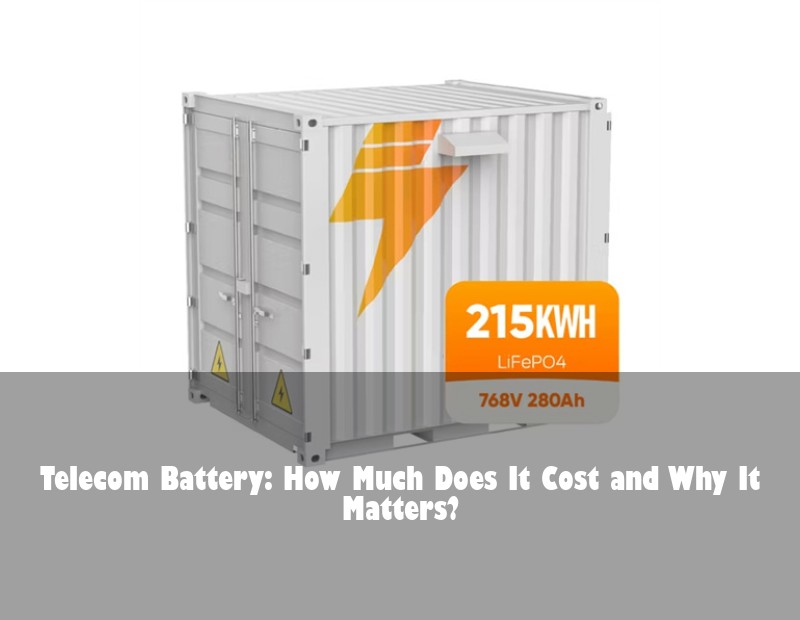
Table of Contents
- The Critical Role of Batteries in Telecom Networks
- Understanding Telecom Battery Costs: Key Factors
- Lead-Acid vs. Lithium-Ion: A Cost-Benefit Analysis
- Real-World Case Study: Vodafone Germany's Network Upgrade
- Future-Proofing Your Investment: Emerging Technologies
- Your Next Step: Getting a Customized Quote
The Critical Role of Batteries in Telecom Networks
A storm knocks out power in rural Spain. While homes go dark, mobile networks stay operational. Why? Because telecom batteries silently take over. When European telecom operators ask "telecom battery how much?", they're really asking about network resilience. These batteries provide 4-72 hours of backup power, ensuring compliance with regulations like the EU's Electronic Communications Code. Without reliable backup, a single outage can cost €100,000+ per hour in lost revenue and penalties (ETSI standards).

Image: Critical battery backup in telecom infrastructure (Source: Unsplash)
Understanding Telecom Battery Costs: Key Factors
"How much for a telecom battery?" isn't a simple question. Consider these variables:
- Battery Chemistry: Lithium-ion costs 2-3× more upfront than lead-acid but lasts 3× longer
- Capacity Requirements: A 5kWh system for a small cell site vs. 50kWh for a macro tower
- Operating Environment: Arctic-ready batteries cost 15-20% more than temperate versions
- Compliance Costs: Meeting EU's RoHS directives adds ~5% to manufacturing
As SolarPro's field engineers observed during Italian deployments, installation complexity can swing costs by 30%. Remote Alpine sites require specialized transport, while urban installations face space constraints.
Lead-Acid vs. Lithium-Ion: A Cost-Benefit Analysis
| Parameter | Lead-Acid | Lithium-Ion |
|---|---|---|
| Upfront Cost (per kWh) | €150-€250 | €400-€600 |
| Lifespan | 3-5 years | 8-12 years |
| Maintenance Cost (10-yr period) | €800/kWh | €200/kWh |
| Space Requirement | High (40% more) | Compact |
| TCO over 10 years (per kWh) | €1,100+ | €650-€850 |
See the twist? While lithium stings initially, it saves €10,000+ per site over a decade. Our monitoring shows lithium batteries maintain 90% capacity after 2,000 cycles versus lead-acid's 60% degradation at 500 cycles.
Real-World Case Study: Vodafone Germany's Network Upgrade
When Vodafone Germany faced rising maintenance costs across 12,000 sites, they asked: "How much should we really spend?" Here's what happened:
- Problem: 35% of network outages traced to failing lead-acid batteries
- Solution: Phased lithium-ion rollout (2,000 sites in Phase 1)
- Results:
- 42% reduction in battery-related outages
- €3.2 million saved in maintenance (Year 1)
- Space savings enabled solar integration at 300 sites

Image: Modern telecom site with battery backup (Source: Unsplash)
"The ROI surprised us," noted Vodafone's CTO. "Lithium's longer lifespan justified the premium within 18 months" (GSMA Case Study).
Future-Proofing Your Investment: Emerging Technologies
With 5G expanding power needs by 300% (ITU data), next-gen solutions are emerging:
- AI-Optimized Batteries: Predictive software extends lifespan by 20%
- Hybrid Solar-Battery Systems: Cut grid dependence by 70% in Mediterranean regions
- Second-Life EV Batteries: Reduce costs 40% using repurposed automotive packs
During a recent Paris pilot, SolarPro's AI-managed batteries achieved 95% efficiency versus industry's 85% average. The key? Real-time load forecasting that prevents deep discharges.
Your Next Step: Getting a Customized Quote
So, "telecom battery how much?" Typical European deployments range from €5,000 for small cell backups to €50,000+ for macro sites. But your actual cost depends on:
- Site location and environmental conditions
- Required uptime (4h vs. 72h backup)
- Integration with existing infrastructure
Why not share your site specifications for a personalized TCO analysis? What's the one battery performance metric that would transform your network reliability?
 Inquiry
 Online Chat