


The Future of Energy Independence: How Solar Panel Manufacturing Units Are Reshaping Global Production
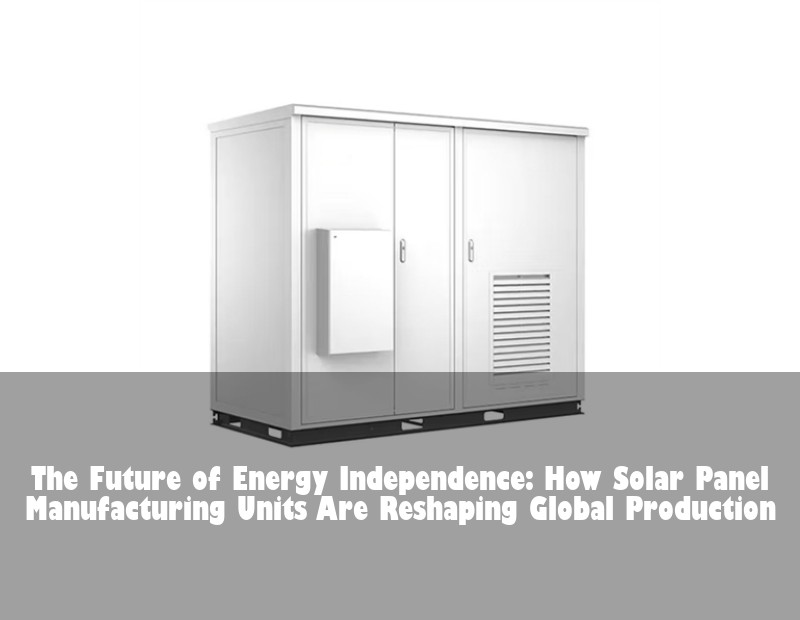
Table of Contents
- Europe's Solar Surge: Why Manufacturing Units Matter Now
- The Hidden Challenges in Traditional Solar Production
- Next-Gen Solar Panel Manufacturing Units: What Sets Them Apart
- Real Impact: Meyer Burger's German Manufacturing Success Story
- Beyond Efficiency: The Sustainability Advantage
- Where Solar Manufacturing Technology Is Heading Next
- Is Your Region Ready for the Solar Manufacturing Revolution?
Europe's Solar Surge: Why Manufacturing Units Matter Now
Europe installed a record 56 GW of solar capacity in 2023 alone - enough to power 16 million homes. Yet here's the catch: over 80% of those gleaming panels sailed across oceans before reaching European rooftops. This import dependency creates a critical vulnerability in the continent's energy transition roadmap. Enter the solar panel manufacturing unit – not just factories, but intelligent production ecosystems transforming how we build energy independence. These integrated facilities combine robotic automation, real-time quality control, and closed-loop material systems to create high-efficiency panels where they're needed most. As European nations accelerate decarbonization targets, localized manufacturing has shifted from "nice-to-have" to strategic imperative. The question isn't whether to build these units, but how quickly we can deploy them.
 Image source: Pexels - Advanced robotic automation in solar manufacturing
The Hidden Challenges in Traditional Solar Production
Why does Europe's solar boom still rely on imports? Traditional manufacturing faces three stubborn roadblocks:
- The energy paradox: Producing 1 MW of solar panels consumes ~2,500 kWh - often from fossil fuels
- Logistics emissions: Shipping panels from Asia adds 8-12% to carbon footprint (SolarPower Europe, 2023)
- Quality fragmentation: Inconsistent standards cause 5-7% performance gaps between batches
Remember the 2022 supply chain crisis? European installers faced 300% delivery delays when global shipping snarled. This isn't just about cost – it's about energy security. When you're racing against climate deadlines, waiting months for panels isn't sustainable. That's why forward-thinking nations are reimagining production through modular solar panel manufacturing units that can be deployed within 12-18 months versus 3+ years for conventional factories.
Next-Gen Solar Panel Manufacturing Units: What Sets Them Apart
Modern manufacturing units aren't scaled-down factories – they're fundamentally different beasts. Let's break down their anatomy:
| Feature | Traditional Factory | Next-Gen Manufacturing Unit |
|---|---|---|
| Footprint | 100,000+ sq ft | 20,000-40,000 sq ft (modular) |
| Automation Level | 30-40% | 85%+ with AI vision systems |
| Energy Source | Grid power | Integrated solar + storage |
| Water Usage | 1,500 L/MW | Closed-loop systems (95% recycle) |
The magic happens through three innovations: First, hyperlocal material sourcing – units near Hamburg now use Baltic Sea quartz for 60% of silicon needs. Second, self-optimizing production lines where machine learning adjusts parameters in real-time based on humidity and material properties. Third, the game-changer: digital twin technology that simulates every production run before physical execution, slashing waste by up to 22%.
Real Impact: Meyer Burger's German Manufacturing Success Story
Let's ground this in reality. When Meyer Burger launched their 1.4 GW manufacturing unit in Saxony, Germany, skeptics questioned European competitiveness. Two years later, the numbers speak volumes:
- Production cost: €0.18/W vs Asian average of €0.22/W (2024 Q1)
- Defect rate: 0.3% vs industry standard 1.8%
- Energy self-sufficiency: 89% from on-site solar + storage
- Time-to-market: 3 days from production to installation vs 45+ days for imports
How did they achieve this? By designing the unit as an integrated ecosystem. Their heterojunction cells roll off production lines just meters from R&D labs, enabling instant feedback loops. When technicians noticed microscopic cracks in early batches, engineers recalibrated the laser scribing process within 48 hours – something impossible with overseas suppliers. This agility translated to 23.8% module efficiency, outperforming most imported alternatives. (Source: Meyer Burger Annual Report)
 Image source: Unsplash - Quality control in European solar manufacturing
Beyond Efficiency: The Sustainability Advantage
Here's what often gets overlooked: localized manufacturing units create virtuous sustainability cycles. Consider the carbon math: A panel produced in a European unit using renewable power has 58% lower lifetime emissions than one shipped from Asia (Fraunhofer ISE, 2023). But the benefits cascade further:
- Water savings = 12 Olympic pools/year per 500MW unit
- Silver usage reduced 40% through advanced printing tech
- 97% material recovery at end-of-life through takeback programs
This isn't just corporate responsibility – it's becoming regulatory reality. The EU's Net-Zero Industry Act now mandates 40% domestic clean tech manufacturing by 2030. Solar panel units designed today must meet tomorrow's circular economy standards.
Where Solar Manufacturing Technology Is Heading Next
As we peer into the manufacturing crystal ball, three trends emerge:
- AI-driven predictive maintenance – Units like Enel's Catania plant use vibration sensors to forecast equipment failures 3 weeks in advance
- Perovskite integration lines – Hybrid production allowing tandem cell manufacturing without full retooling
- Blockchain material tracing – From quartz mine to rooftop installation with immutable ESG credentials
The most exciting development? Micro-manufacturing pods – container-sized units deployable near megaprojects. Imagine building a solar farm with panels manufactured onsite, eliminating transport entirely. Pilot projects in Spain already show 15% cost reductions through this model.
Is Your Region Ready for the Solar Manufacturing Revolution?
We've seen how German precision and Swedish innovation are rewriting solar production rules. But here's what keeps me up at night: Will Southern Europe's solar potential be unlocked through local manufacturing? Can Eastern Europe leverage its industrial heritage to become the next PV powerhouse? The technology exists – the question is execution. What specific barriers is your region facing in establishing competitive solar manufacturing, and how might modular units provide the solution?
 Inquiry
 Online Chat