


Harness the Power of Solar Electricity for Your Home: A Smart Energy Revolution
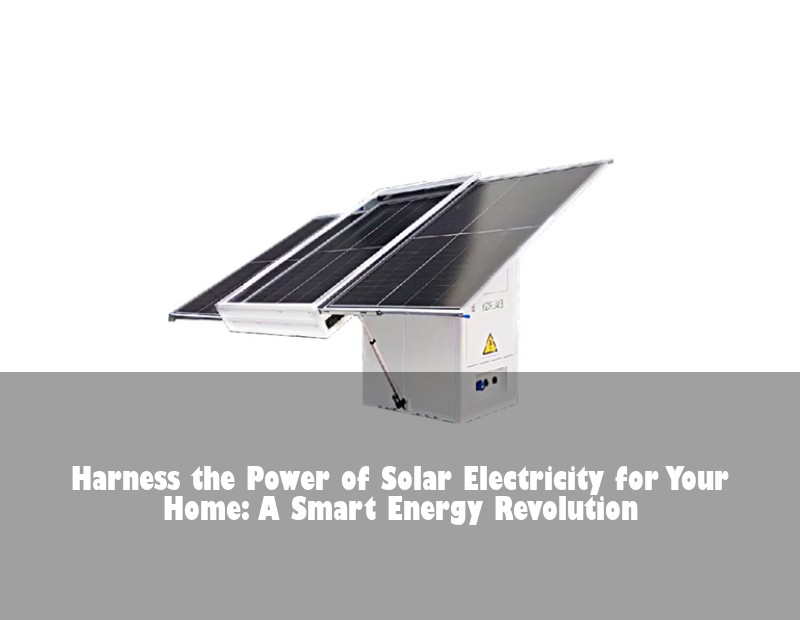
Feeling the pinch of rising energy bills? You're not alone. Across Europe, households are grappling with volatile electricity prices and growing environmental concerns. But what if there was a way to take control, generate your own clean power, and achieve greater energy independence right at home? The solution is shining down on us every day: solar electricity for your home. This isn't just a trend; it's a fundamental shift in how we power our lives, offering resilience, savings, and a tangible step towards a sustainable future.
Table of Contents
- The Rising Cost & Environmental Impact of Grid Dependence
- Solar Power: Your Personal Energy Solution
- Unlocking True Independence: The Role of Energy Storage
- Real-World Impact: A German Family's Solar Success Story
- Making the Financials Work: Incentives and Payback
- Choosing the Right Solar + Storage System for Your Home
- The Future-Proof Home: Resilience and Sustainability
- Is Your Home Ready for the Solar Revolution?
The Rising Cost & Environmental Impact of Grid Dependence
European energy markets have experienced unprecedented volatility in recent years. Wholesale electricity prices surged dramatically, directly impacting household bills. The European Commission reports average household electricity prices increased by over 30% in many member states between 2021 and 2023. This financial strain is coupled with the urgent need to reduce carbon footprints. Traditional grid electricity, still heavily reliant on fossil fuels in many regions, contributes significantly to greenhouse gas emissions. Relying solely on the grid means being vulnerable to both price shocks and contributing to the environmental challenges we face.
Solar Power: Your Personal Energy Solution
Photovoltaic (PV) technology converts sunlight directly into usable electricity. Modern solar panels are incredibly efficient, even in diverse European climates – it's about capturing daylight, not just direct summer sun. A typical residential solar system consists of:
- Solar Panels: Capture sunlight and generate direct current (DC) electricity.
- Inverter(s): Convert the DC electricity into alternating current (AC) used in your home.
- Mounting System: Securely fixes panels to your roof or ground.
- Monitoring System: Tracks energy production and consumption in real-time.

Source: U.S. Department of Energy (Conceptual diagram illustrating typical home solar components)
The immediate benefit? You start generating your own clean electricity, significantly reducing your reliance on the grid and your exposure to its price fluctuations. Any excess electricity you produce during sunny periods can often be fed back to the grid, potentially earning you credits or payments through feed-in tariffs (FiTs) or net metering schemes, depending on your country's regulations.
Unlocking True Independence: The Role of Energy Storage
While solar panels generate power during the day, your energy needs extend into the evening and night. This is where adding a home battery storage system becomes transformative. Instead of sending excess solar energy back to the grid (often at a lower rate than you pay to buy it back later), you store it for your own use when the sun isn't shining. This dramatically increases your self-consumption rate – the percentage of your solar energy you use directly.
- Increased Self-Consumption: Use 70-80%+ of your solar energy directly, minimizing grid imports.
- Energy Security: Power essential appliances during grid outages (with the right inverter setup).
- Maximized Savings: Avoid buying expensive peak-time grid electricity.
- Grid Support: Advanced systems can even help stabilize the local grid.
Modern lithium-ion batteries, like those using LiFePO4 chemistry, offer high efficiency, long lifespans (often 10+ years or 6000+ cycles), and decreasing costs. Integrating storage turns your solar system from a partial solution into a comprehensive home energy management system.
Comparing Common Home Battery Technologies
| Technology | Typical Lifespan (Cycles) | Depth of Discharge (DoD) | Key Advantages | Considerations |
|---|---|---|---|---|
| Lithium Iron Phosphate (LiFePO4) | 6,000+ | 90%+ | Long lifespan, high safety, stable performance, good temperature tolerance | Slightly lower energy density than NMC, cost |
| Nickel Manganese Cobalt (NMC) | 3,000 - 5,000 | 80-90% | High energy density, compact size | Thermal management critical, lifespan can be shorter than LiFePO4 |
| Lead-Acid (Advanced) | 1,000 - 1,500 | 50% | Lower upfront cost, well-established technology | Shorter lifespan, lower DoD, larger size/weight, maintenance |
Real-World Impact: A German Family's Solar Success Story
Let's look at the Müller family near Hamburg, Germany. Facing high electricity costs (€0.35/kWh) and motivated by sustainability, they installed a 9.8 kWp solar system with a 10 kWh LiFePO4 battery in early 2022.
- System Cost (after incentives): ~€18,000 (Including installation and VAT reduction).
- Annual Electricity Production: ~8,900 kWh (Sufficient to cover ~85% of their 10,500 kWh annual demand).
- Self-Consumption Rate (with battery): Increased from ~35% (solar only) to ~78%.
- Annual Savings: Reduced grid imports by ~8,300 kWh, saving ~€2,900 per year on electricity bills.
- Estimated Payback Time: Approximately 6.2 years (factoring in current energy prices and minor FiT for minimal excess).
Beyond the numbers, the Müllers value their energy independence and reduced carbon footprint, estimated at over 4 tonnes of CO2 avoided annually. Their system, monitored via a user-friendly app, provides peace of mind and tangible control. Fraunhofer ISE data confirms Germany's booming residential PV+storage market, driven by similar motivations across countless households.

Source: SolarPower Europe (Infographic illustrating EU residential solar growth trends)
Making the Financials Work: Incentives and Payback
The economics of solar electricity for your home are increasingly compelling, especially when combined with storage. While upfront costs exist, consider these factors:
- Falling Technology Costs: Solar panel prices have dropped over 80% in the last decade. Battery costs are also declining steadily.
- Government Incentives: Many European countries offer significant support:
- Reduced VAT rates (e.g., 0% in the UK, 5.5% in France on solar installations).
- Feed-in Tariffs (FiTs) or Smart Export Guarantees (SEGs) paying for excess energy exported.
- Direct grants or rebates for solar and/or battery installations (e.g., KfW loans in Germany, MaPrimeRénov' in France).
- Rising Grid Electricity Prices: As grid prices increase, the value of every self-consumed kWh of solar electricity rises, shortening payback periods.
- Increased Property Value: Studies, like those from the U.S. Department of Energy, suggest homes with solar systems often sell faster and at a premium.
Calculating your specific payback requires a detailed assessment based on your location, energy consumption, roof suitability, and available incentives. Reputable installers provide detailed financial analyses.
Choosing the Right Solar + Storage System for Your Home
Selecting an optimal system involves several key considerations:
- Energy Audit: Understand your household's annual and seasonal electricity consumption patterns. Look at your bills.
- Roof Assessment: Direction (south-facing optimal in the Northern Hemisphere), tilt angle, shading (trees, chimneys), and structural integrity.
- System Sizing: Balance your goals (maximize self-consumption, offset a specific bill percentage, backup power) with budget and roof space. A good installer models this.
- Component Quality: Choose Tier-1 solar panels with strong warranties (product & performance), high-efficiency inverters (Hybrid inverters are essential for storage), and reputable battery brands with proven safety and longevity.
- Smart Energy Management: Opt for systems with intelligent software that optimizes when to charge/discharge the battery based on solar production, consumption patterns, and even variable electricity tariffs.
- Professional Installation & Accreditation: Use certified installers (e.g., MCS in the UK, RGE in France) for safety, compliance, and warranty validity.
The Future-Proof Home: Resilience and Sustainability
Investing in solar electricity for your home with storage is more than just saving money; it's about building a resilient, future-proof household. As extreme weather events potentially impact grid stability, having your own stored power provides crucial backup. Electrification of heating (heat pumps) and transport (EVs) is accelerating. Solar and storage provide the clean, cost-effective foundation to power these technologies efficiently. You're not just reducing your current bills; you're locking in lower energy costs for decades, insulating yourself from future price hikes, and making a direct, positive contribution to decarbonizing the energy system.
Is Your Home Ready for the Solar Revolution?
The technology is proven, the financial case strengthens as energy prices rise, and the environmental imperative is clear. Solar electricity for your home, especially paired with intelligent storage, offers a path to genuine energy independence, significant savings, and a sustainable lifestyle. What's the first step you'll take today to understand your home's solar potential? Could your roof be your most valuable asset in the energy transition?
 Inquiry
 Online Chat