


Rackmount Battery Backup: Your Scalable Shield Against Power Uncertainty
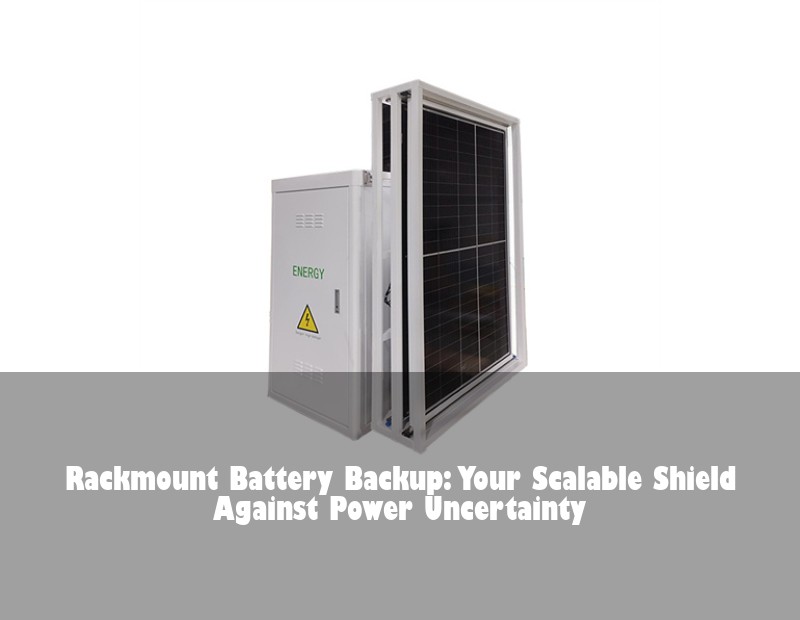
Table of Contents
- The Unpredictable Grid: A Growing European Challenge
- Rackmount Battery Backup: The Modular Powerhouse Solution
- Why Rackmount Systems Dominate Commercial & Industrial Backup
- Real-World Impact: A German Case Study in Resilience
- Key Technical Considerations for Optimal Deployment
- Future-Proofing Your Energy Strategy
The Unpredictable Grid: A Growing European Challenge
a critical manufacturing process halts mid-cycle. A data center server flickers offline. A supermarket's refrigeration units lose power. Across Europe, businesses and institutions are increasingly vulnerable to grid instability. Extreme weather events driven by climate change, aging infrastructure, and the complex integration of renewable energy sources create a volatile power landscape. The European Commission's 2023 Energy Statistical Pocketbook highlights a concerning trend: the frequency and duration of power disruptions vary significantly, but the financial and operational impact is universally severe. For many, relying solely on the grid is no longer a viable strategy. This is where robust rackmount battery backup systems step in, transforming vulnerability into resilience.

Image: European energy infrastructure faces increasing pressure (Source: Unsplash, Photographer: Mika Baumeister).
Rackmount Battery Backup: The Modular Powerhouse Solution
So, what exactly is a rackmount battery backup? Unlike single-unit power stations, these systems are built around standardized 19-inch rack units, similar to IT server equipment. Individual battery modules (typically 2U-5U in height) are installed into sturdy metal racks. This modular design offers unparalleled advantages:
- Scalability: Start with the capacity you need today and seamlessly add modules as your energy demands grow.
- Space Efficiency: Vertical integration maximizes power density, ideal for constrained server rooms, basements, or dedicated energy rooms.
- Serviceability: Individual modules can be replaced or serviced without taking the entire system offline.
- Integration: Designed to work harmoniously with inverters, solar PV arrays, and energy management systems (EMS).
Think of it as building your energy security brick by brick, tailored precisely to your critical load requirements.
Why Rackmount Systems Dominate Commercial & Industrial Backup
The shift towards rackmount battery backup isn't just a trend; it's driven by hard economics and operational realities. Generators, while powerful, have limitations: fuel dependency, maintenance burdens, noise, emissions, and delayed start-up times. Rackmount Li-ion battery systems offer:
| Feature | Rackmount Battery Backup | Traditional Generator |
|---|---|---|
| Response Time | Instantaneous (Milliseconds) | Seconds to Minutes |
| Fuel Source | Electricity (Grid/Solar) | Diesel/Gas |
| Maintenance | Low (Primarily Monitoring) | High (Regular Servicing) |
| Emissions | Zero During Operation | High (CO2, NOx, Particulates) |
| Noise | Minimal (Cooling Fans Only) | Significant |
| Scalability | Easy Module Addition | Requires Larger Unit |
For critical IT infrastructure, sensitive manufacturing processes, or facilities needing silent operation (hospitals, labs), the instant, clean, and quiet response of a rackmount battery backup is indispensable.
Real-World Impact: A German Case Study in Resilience
Let's move beyond theory. Consider a mid-sized food processing plant in Bavaria, Germany. Facing frequent micro-outages disrupting refrigeration and production lines, they deployed a 120 kWh rackmount battery backup system integrated with their existing rooftop solar. The results, monitored over 18 months, were compelling:
- Outage Mitigation: Seamlessly handled 14 grid interruptions > 15 minutes, preventing €85,000+ in potential spoilage and downtime costs.
- Energy Cost Savings: Used solar energy stored during the day to power critical loads during peak evening rates (saving ~€3,200/month via arbitrage).
- ROI: Projected system payback achieved in under 5 years, combining outage protection savings and reduced grid consumption. Data aligns with the Fraunhofer ISE's findings on industrial battery economics.

Image: Rackmount battery systems are ideal for industrial backup power needs (Source: Pexels, Photographer: Kindel Media).
"The predictability and silence of the battery system were game-changers," noted the plant's facilities manager. "We didn't realize how much stress the old generators caused until they were no longer our primary backup."
Key Technical Considerations for Optimal Deployment
Deploying an effective rackmount battery backup requires careful planning. Here’s what truly matters:
- Capacity & Power (kWh/kW): Precisely calculate your critical load requirements (both energy needed in kWh and instantaneous power in kW). Oversizing wastes capital; undersizing compromises protection. A professional energy audit is crucial.
- Depth of Discharge (DoD) & Cycle Life: Understand the usable capacity (e.g., 90% DoD) and the expected lifespan (e.g., 6,000 cycles to 80% capacity). Higher quality Li-ion chemistries (like LiFePO4) offer superior longevity and safety.
- BMS & Communications: A sophisticated Battery Management System (BMS) is non-negotiable for safety, performance monitoring, cell balancing, and lifespan optimization. Ensure compatibility with your EMS/inverter protocols (Modbus, CAN, etc.).
- Environmental Conditions: Rackmount systems require a controlled environment. Temperature extremes dramatically impact performance and lifespan. Ensure adequate ventilation/cooling and space compliant with local fire codes (DNV GL standards provide valuable guidance).
- Grid Compliance: Ensure the system and its inverter meet all relevant local grid codes (e.g., VDE-AR-N 4105 in Germany, G99 in the UK) for safety and injection standards.
Future-Proofing Your Energy Strategy
The role of rackmount battery backup is evolving beyond pure emergency power. These systems are becoming dynamic energy assets. Imagine using your stored energy not just during outages, but also to:
- Participate in grid-balancing services (Frequency Containment Reserve - FCR), generating revenue streams.
- Maximize self-consumption of solar PV, drastically reducing grid dependence.
- Act as a buffer during peak demand charges, slashing utility bills.
Choosing a modular, intelligent rackmount battery backup system positions you to capitalize on these future energy market opportunities. The technology isn't just about surviving the next outage; it's about actively managing and optimizing your energy ecosystem for resilience and cost efficiency.
What energy resilience challenge keeps you up at night? How could integrating a scalable, intelligent energy storage solution transform your operations or service delivery? Share your thoughts below or reach out to explore how rackmount technology can be tailored to your specific European energy landscape.
 Inquiry
 Online Chat