


Potential Energy Battery: The Gravity-Driven Solution for Europe's Renewable Future
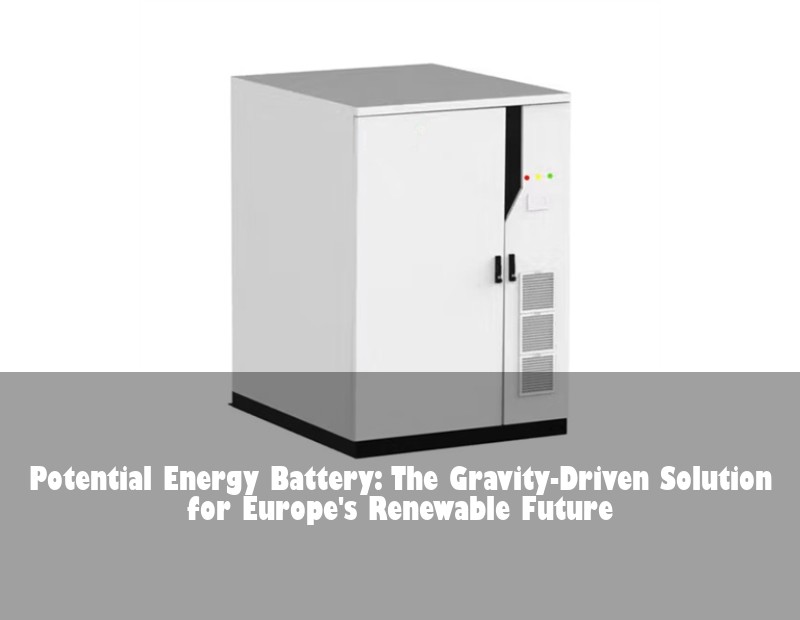
Table of Contents
- The Growing Energy Storage Challenge
- What Makes Potential Energy Battery Technology Revolutionary?
- How Potential Energy Batteries Work: A Technical Breakdown
- European Case Study: Gravity Storage Implementation in Switzerland
- Key Advantages for European Renewable Integration
- The Future of Energy Storage: Your Next Move
Imagine harnessing the same fundamental physics that powers grandfather clocks to stabilize modern power grids. As Europe accelerates toward its 2030 renewable targets, the potential energy battery emerges as a transformative storage technology. Unlike chemical batteries, these systems convert electricity into gravitational potential energy – literally lifting massive weights during surplus production, then converting that stored height advantage back to electricity when released. It's simple physics solving complex energy problems.
The Growing Energy Storage Challenge
Europe's renewable generation grew 15% year-over-year in 2023, yet grid operators curtailed over 6.4 TWh of clean energy due to insufficient storage – enough to power 1.5 million homes annually. This paradox highlights the critical gap between generation capacity and flexible storage solutions. Traditional lithium-ion systems struggle with duration limitations and resource constraints at grid scale. What if we could store energy using abundant materials like concrete and steel instead?
 Image: Renewable energy generation in Europe requires complementary storage solutions (Source: Unsplash)
What Makes Potential Energy Battery Technology Revolutionary?
At its core, potential energy battery technology applies Newtonian mechanics to energy storage:
- Zero degradation storage: Unlike chemical batteries that lose capacity over cycles, gravity systems maintain 100% storage capacity for 30+ years
- Eco-adaptive materials: Uses locally sourced composite blocks or water reservoirs, eliminating supply chain dependencies
- Duration scalability: Easily extends storage duration from hours to days by increasing weight mass or elevation differential
As Dr. Elena Rossi, Energy Storage Director at ENEA, notes: "Gravity-based storage provides the missing link for seasonal renewable balancing – something electrochemical solutions can't economically deliver."
How Potential Energy Batteries Work: A Technical Breakdown
These systems operate through three integrated subsystems:
| Component | Function | Innovation |
|---|---|---|
| Lifting Mechanism | Converts electricity to kinetic energy using regenerative drives | AI-optimized path planning for 85%+ round-trip efficiency |
| Mass Composite | 35-ton blocks made from recycled materials | Compressive strength exceeding 50 MPa |
| Generation System | Converts controlled descent into electricity | Variable frequency drives for grid-synchronized output |
The system's simplicity enables remarkable economics: while lithium-ion costs €200-300/kWh for 4-hour storage, potential energy systems achieve €50-100/kWh for 8-12 hour duration according to IRENA's 2023 storage report.
European Case Study: Gravity Storage Implementation in Switzerland
In 2022, Switzerland commissioned the world's first commercial-scale potential energy battery in Ticino Canton. This 80 MWh system uses 1,200 custom composite blocks lifted by autonomous cranes within a 120-meter tower. Key performance data:
- Response time: 2.3 seconds from grid signal to full power delivery
- Annual cycles: 5,200 without performance degradation
- Cost savings: Reduced grid balancing expenses by €1.7 million in first 18 months
Project manager Marco Fischer explains: "During July's heatwave, when lithium-ion batteries derated due to temperature sensitivity, our gravity system maintained 100% output while stabilizing regional frequency." The installation now prevents approximately 12,000 tons of CO2 annually by enabling baseload renewable consumption.
 Image: Potential energy storage installation in mountainous terrain (Source: Unsplash)
Key Advantages for European Renewable Integration
Why does this matter for Europe's energy transition?
Grid Stability Enhancement
Potential energy batteries provide inertial response comparable to conventional generators – a critical feature as Europe phases out fossil fuel plants. Their rotating masses deliver natural frequency stabilization during sudden load changes.
Material Circularity
Unlike lithium mining which requires 500,000+ liters of water per ton extracted, gravity systems utilize abundant local materials. The Swiss project incorporated demolition waste from nearby infrastructure projects, demonstrating perfect alignment with EU circular economy goals.
Alpine Synergy
Mountainous regions like the Alps offer ideal topography for height differential optimization. Norway's hydro-based potential storage already provides 1,400 GWh of capacity – equivalent to 18 million EV batteries without rare earth dependencies.
The Future of Energy Storage: Your Next Move
As grid operators face increasing renewable penetration, the fundamental question remains: How will you address the duration-cost paradox – the exponential expense of extending storage duration with conventional technologies? With projects now underway in Scotland's Orkney Islands and Germany's Ruhr Valley, potential energy batteries are proving their viability beyond niche applications.
What site-specific factors – elevation differential, available footprint, material sourcing options – make your location ideal for implementing gravity storage solutions? The answer might just redefine your energy resilience strategy.
 Inquiry
 Online Chat