


Off Grid Solar Systems South Africa: Pioneering Energy Independence for Global Adoption
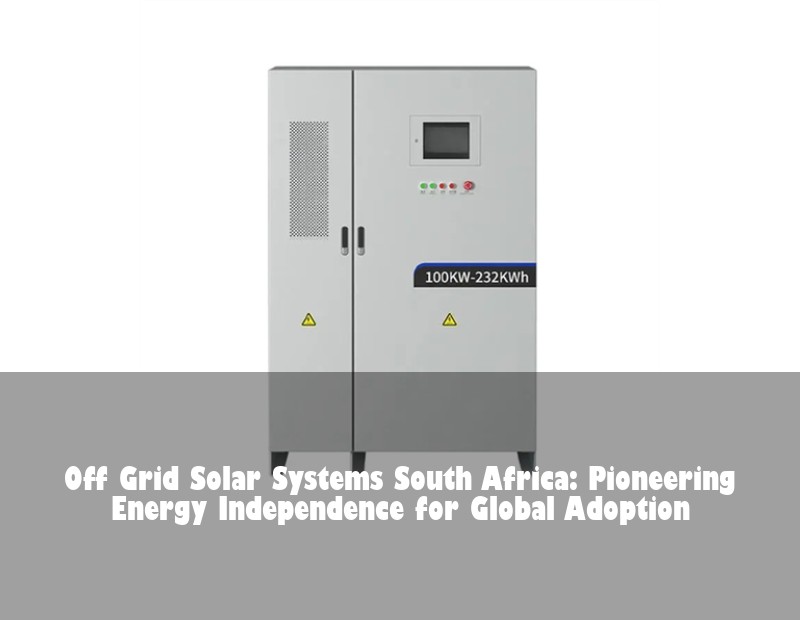
South Africa's relentless load shedding crisis has unintentionally positioned it as a global testbed for off-grid solar innovation. With over 200 days of power outages in 2023 alone, households and businesses have turned to solar-plus-storage solutions not just as backups, but as primary energy sources. This hard-won expertise now offers valuable insights for European communities facing similar energy security challenges. Let's explore how South Africa's off-grid revolution is reshaping energy paradigms worldwide.
Table of Contents
- The Rising Global Demand for Off-Grid Solar
- European Case Study: Germany's Off-Grid Transformation
- Core Components of Efficient Off-Grid Systems
- South Africa's Cutting-Edge Innovations
- Implementation Guide: From Assessment to Activation
- Future Trends in Decentralized Energy
The Rising Global Demand for Off-Grid Solar
Europe's energy landscape is undergoing seismic shifts. Following Russia's invasion of Ukraine, EU electricity prices surged by 69% in 2022, exposing critical vulnerabilities in centralized grids. This phenomenon mirrors South Africa's decade-long struggle with Eskom's unreliable infrastructure, where off-grid solar installations grew by 350% between 2018-2023.
Key Drivers Behind the Surge
- Energy Security: 72% of European businesses now consider power independence a strategic priority (Eurostat 2023)
- Cost Efficiency: Solar LCOE has dropped 89% since 2010, outperforming fossil fuels
- Climate Resilience: Off-grid systems provide critical backup during extreme weather events

Image: Off-grid solar installation in rural setting. Credit: Unsplash/Photographer
European Case Study: Germany's Off-Grid Transformation
The Bavarian village of Wildpoldsried exemplifies Europe's off-grid transition. After experiencing 12 grid failures in 2021, the community deployed a 200kW microgrid combining solar, wind, and lithium-ion storage. The results?
| Metric | Pre-Installation | Post-Installation |
|---|---|---|
| Energy Reliability | 87% | 99.98% |
| Annual Savings | €0 | €42,000 |
| CO2 Reduction | 0 tons | 78 tons |
"Our energy independence has become an economic shield," says Mayor Arno Zengerle. "When neighboring towns face blackouts, our bakery ovens keep running." This mirrors South Africa's success in regions like Stellenbosch, where solar microgrids now power entire winery operations during load shedding.
Core Components of Efficient Off-Grid Systems
Modern off-grid systems blend South African durability with European precision engineering:
The Energy Trinity
- Solar Modules: Bifacial panels capturing 20% more energy (vs. monofacial)
- Intelligent Storage: LiFePO4 batteries with 6000+ cycle lifespans
- Hybrid Inverters: AI-powered units that prioritize renewable consumption
What makes South African designs unique? They incorporate "load shedding mode" programming - instantly switching to battery power during outages without milliseconds of interruption. This technology is now being adopted in Portugal and Greece, where grid instability is increasing.
South Africa's Cutting-Edge Innovations
Necessity has bred remarkable ingenuity in the South African solar sector:
Breakthrough Technologies
- Dynamic Load Management: Systems that automatically shed non-essential loads during low production
- Water-Saving Panel Cooling: Recirculating systems that boost efficiency by 15% in arid climates
- Modular Scalability: "Pay-as-you-grow" designs allowing incremental capacity additions
These innovations are proving invaluable in Southern Europe. A Maltese hospital recently implemented South African-designed battery cascading technology, extending backup power from 8 hours to 72 hours during grid failures.
Implementation Guide: From Assessment to Activation
Deploying reliable off-grid power requires meticulous planning:
Four Critical Steps
- Energy Auditing: Calculate your true power needs including peak demand spikes
- Site Optimization: Position panels for maximum seasonal exposure (avoid winter shading)
- Technology Matching: Pair high-efficiency panels with compatible battery chemistry
- Fail-Safe Protocols: Implement automatic generator kick-in for extended low-sun periods

Image: Solar system installation and monitoring. Credit: Unsplash/Photographer
Future Trends in Decentralized Energy
Off-grid systems are evolving from isolated solutions to interconnected ecosystems:
The Next Frontier
- Peer-to-Peer Energy Trading: Blockchain-enabled microgrids allowing neighbors to exchange surplus power
- Predictive AI: Algorithms forecasting energy needs based on weather/usage patterns
- Vehicle-to-Grid Integration: Using EV batteries as mobile energy reservoirs
South African townships are already piloting community solar gardens where residents without rooftop access can "subscribe" to local solar farms - a model now being tested in Ireland's renewable communities. As battery costs continue falling (33% reduction projected by 2025), off-grid systems will become the norm rather than the exception.
What energy independence milestone could your business achieve with 12 months of reliable power?
Share your vision for decentralized energy in the comments below - let's build the blueprint for energy resilience together.
 Inquiry
 Online Chat