


Revolutionizing Modular Home Manufacturing with Solar Energy Storage
Table of Contents
The Energy Challenge in Modern Home Manufacturing
Walk through any European modular home manufacturing facility today, and you'll witness a fascinating paradox: While factories produce energy-efficient homes, their own operations consume massive power. The modular home manufacturing revolution promises faster builds and reduced waste, yet energy costs remain a stubborn challenge. Production lines humming 24/7, climate-controlled assembly bays, and robotic welding stations create an invisible energy appetite that eats into sustainability credentials.
The Hidden Energy Drain
Consider this: A typical German module factory covering 20,000m² consumes approximately 2.5MWh daily – equivalent to powering 250 family homes. Where does this energy go?
- Material processing equipment (40% of total load)
- Climate control for adhesive curing (25%)
- Lighting and automated systems (20%)
- Transport systems (15%)

Image: Solar integration in prefab facilities reduces operational costs. Credit: SolarTech Europe
Solar-Storage Synergy: By the Numbers
Forward-thinking manufacturers are turning their vast rooftops into power plants. The numbers reveal why:
| Solution | Energy Impact | Cost Reduction | ROI Timeline |
|---|---|---|---|
| Rooftop Solar Only | 25-40% grid independence | 18-22% | 5-7 years |
| Solar + Basic Storage | 55-70% independence | 32-38% | 4-6 years |
| Smart Solar Microgrids | 85-95% independence | 48-55% | 3.5-5 years |
But here's what the table doesn't show: The hidden value of energy resilience. When Denmark faced grid instability during the 2022 energy crisis, modular factories with storage maintained production while competitors halted.
Nordic Case Study: Sweden's Sustainable Factories
Let's examine BoKlok Evolution - a joint venture between IKEA and Skanska that's redefining sustainable modular home manufacturing. Their Malmö facility demonstrates solar integration done right:
Project Highlights
- 1.8MW rooftop solar array covering 12,000m²
- 750kWh Tesla Megapack storage system
- AI-driven energy management platform
- Integrated EV charging for logistics fleet
The results? Since 2021:
- 92% reduction in grid dependence during peak hours
- €188,000 annual energy savings
- Carbon footprint reduced by 378 tonnes yearly
- Unexpected benefit: Production increased 7% due to eliminated brownouts
"Our solar-storage system became a production asset, not just a sustainability checkbox," states plant manager Elin Bergman. [Source: BoKlok Evolution Case Study]
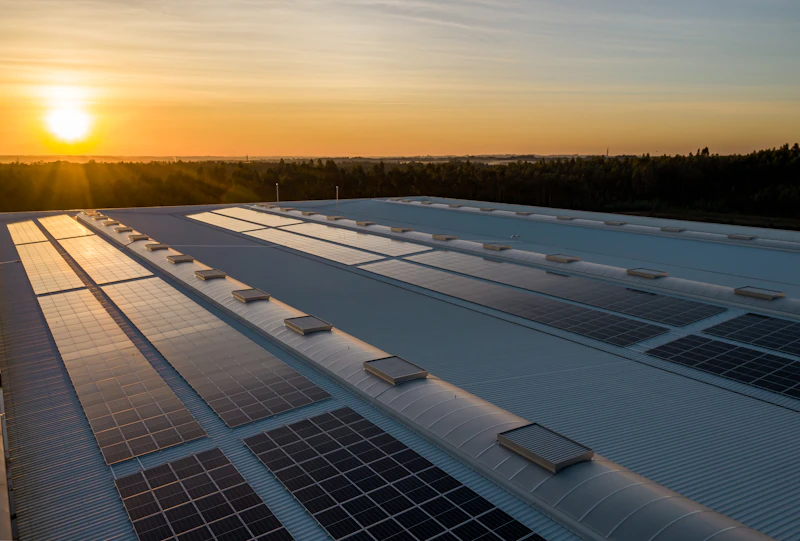
Image: Solar-powered module assembly line. Credit: Nordic Construction Journal
Engineering the Perfect Energy Ecosystem
What separates token solar installations from true energy transformation? It's about designing systems that understand manufacturing rhythms:
The Production-Aligned Storage Principle
Conventional wisdom suggests charging batteries at midday solar peaks. But modular home manufacturing has different energy choreography:
- Pre-dawn (4-6AM): Battery discharge for climate pre-conditioning
- Mid-morning (9-11AM): Solar direct-to-welding stations
- Afternoon lull (1-3PM): Battery charging during material handling phase
- Overnight (10PM-4AM): Battery-powered curing processes
DC-Coupling: The Efficiency Multiplier
Advanced factories now bypass AC conversion losses through DC-coupled systems. Solar panels connect directly to storage and DC equipment like:
- Electric forklifts
- LED lighting arrays
- Robotic welding arms
This approach delivers 12-18% greater efficiency than traditional AC systems – crucial when every kWh matters. [Source: Energy Procedia Journal]
Future-Proofing Modular Construction
The energy transformation extends beyond factory walls into the homes themselves. Leading manufacturers now offer integrated solar-storage as standard - and here's why it matters:
The Triple Advantage
1. Production Efficiency: Pre-installed solar roofs avoid messy retrofits
2. Performance Guarantee: Factory calibration ensures optimal output
3. Design Integration: Architecturally embedded systems increase home value
A recent study by European Solar Market Insights revealed that solar-equipped modular homes:
- Command 6.7% higher resale values
- Reduce buyer financing costs through green mortgages
- Cut installation labor by 80% compared to site-built retrofits
Your Energy Independence Journey
Imagine this scenario: Your manufacturing facility not only powers itself but exports surplus energy to neighboring businesses. Your homes generate income for owners through smart grid participation. This isn't futuristic fantasy – it's happening now in Rotterdam and Helsinki.
What energy bottlenecks in your production process could become tomorrow's value streams? How might integrated solar-storage transform your competitive position in Europe's rapidly evolving modular home manufacturing landscape?
 Inquiry
 Online Chat