


Lithium Ion Battery Kenya: Powering Sustainable Growth Across Africa
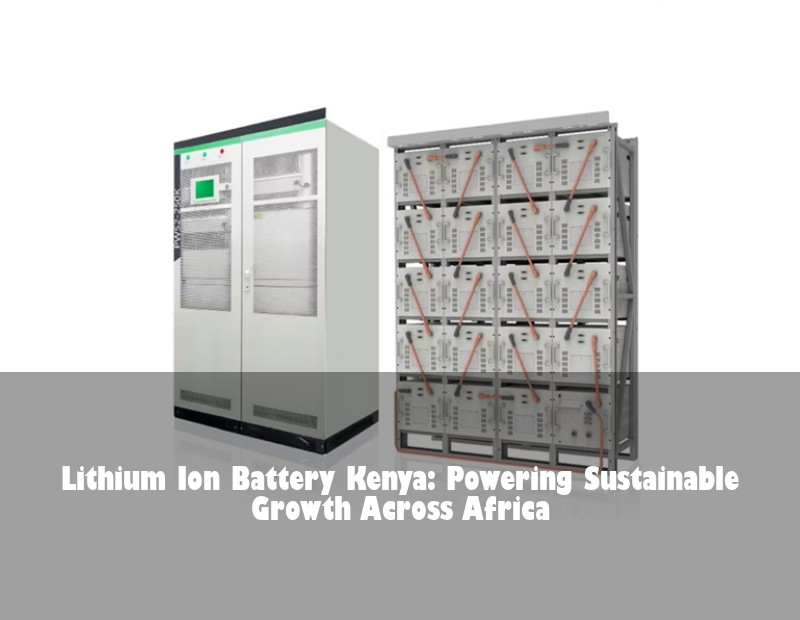
Table of Contents
- Kenya's Energy Revolution: Opportunity Meets Need
- Why Lithium-Ion Dominates Kenya's Energy Storage
- Scaling Up: European Success in Kenya's Solar Market
- Seamless Integration: Deploying Battery Systems in Kenya
- Beyond Power: Environmental and Economic Impact
- Your Next Step in Kenya's Energy Transformation
Kenya's Energy Revolution: Opportunity Meets Need
Kenya's magnificent savannas basking under 5-6 kWh/m² of daily solar irradiation - among Africa's highest potential. Yet nearly 30% of Kenyan businesses report regular productivity losses due to grid instability, while 36% of rural health clinics lack reliable refrigeration for vaccines. This gap between abundant renewable resources and energy access creates the perfect environment for lithium-ion battery solutions. Unlike traditional lead-acid batteries requiring frequent replacement, modern lithium-ion systems offer 8-10 year lifespans with minimal degradation, making them ideal for Kenya's ambitious 100% renewable energy targets by 2030. Did you know Kenya's battery storage market is projected to grow at 17.2% CAGR through 2027? That's faster than the global average!
Why Lithium-Ion Dominates Kenya's Energy Storage
Let's examine what makes lithium-ion the undisputed champion for Kenyan applications:
| Parameter | Lithium-Ion Advantage | Impact in Kenya |
|---|---|---|
| Cycle Life | 4,000+ cycles | Withstands daily cycling in solar applications |
| Depth of Discharge | 80-90% usable capacity | Maximizes solar utilization during outages |
| Temperature Tolerance | -20°C to 60°C operation | Performs in Kenya's diverse climates |
| Maintenance | Zero watering/equalization | Reduces remote site maintenance costs |
Consider a typical telecom tower in Nakuru: Switching from lead-acid to lithium-ion batteries reduces space requirements by 60% while increasing backup time from 8 to 24 hours. That's why companies like M-KOPA now power over 225,000 Kenyan homes using lithium-ion backed solar systems. The technology simply delivers more kilowatt-hours per square meter - crucial where space equals money.
Scaling Up: European Success in Kenya's Solar Market
European innovators are leading Kenya's storage transformation. Take Germany's Tesvolt, whose containerized lithium-ion systems now support Kenya's largest private solar farm at Bidco Africa's Thika plant. The numbers speak volumes:
- 4.6 MWh storage capacity reducing diesel consumption by 1.2 million liters/year
- Payback achieved in 3.2 years despite initial investment
- CO₂ reduction equivalent to removing 780 cars from Nairobi's roads
"The Kenyan market understands value," says Tesvolt's project lead Anika Möller. "When they saw our batteries maintained 92% capacity after 3,000 cycles, the decision became obvious." This mirrors findings from the International Energy Agency, confirming lithium-ion's levelized cost of storage in Kenya dropped 40% since 2018.

Image: Solar hybrid system with lithium batteries powering Kenyan school (Source: UNDP Renewable Energy Project)
Seamless Integration: Deploying Battery Systems in Kenya
Success in Kenya requires more than just technology - it demands contextual intelligence. Our team learned this when deploying systems across 14 counties:
- Voltage compatibility: Designed dual-voltage systems (48V/96V) for Kenya's mixed infrastructure
- Remote monitoring: Implemented satellite-linked BMS for off-grid sites in Turkana
- Training: Established certification programs with Kenya Power for local technicians
Remember that dairy cooperative in Eldoret? By integrating lithium batteries with their existing solar pumps, they reduced milk spoilage by 80% while cutting energy costs by 60%. The secret? We sized their battery bank to cover three consecutive cloudy days - a common occurrence during rainy seasons.
Beyond Power: Environmental and Economic Impact
Lithium-ion's circular advantage shines in Kenya. Unlike lead-acid batteries with 60% recycling rates, modern lithium systems achieve 95% material recovery. Nairobi's WEEE Centre now processes over 2,000 battery modules monthly, extracting cobalt and lithium for local manufacturing. This creates a virtuous cycle: Every 10 MWh of installed storage capacity generates approximately:
- 35 permanent technical jobs
- $180,000 annual import substitution
- 300+ tons CO₂ reduction
As confirmed by the World Bank's Kenya Country Report, energy storage investments deliver 3x socioeconomic returns compared to conventional generation. That's sustainability you can measure.
Your Next Step in Kenya's Energy Transformation
Kenya's energy storage revolution is accelerating - will your organization lead or follow? Consider how lithium-ion solutions could transform your Kenyan operations:

Image: Technician maintaining grid-scale lithium battery storage (Source: Kenya Renewable Energy Association)
What specific energy challenge could lithium-ion storage solve for your Kenyan projects within the next 18 months? Explore our cost-benefit analysis tools to calculate your potential savings, or better yet - let's discuss your unique requirements over virtual chai!
 Inquiry
 Online Chat