


Leclanche Energy Storage: Powering Europe's Renewable Future
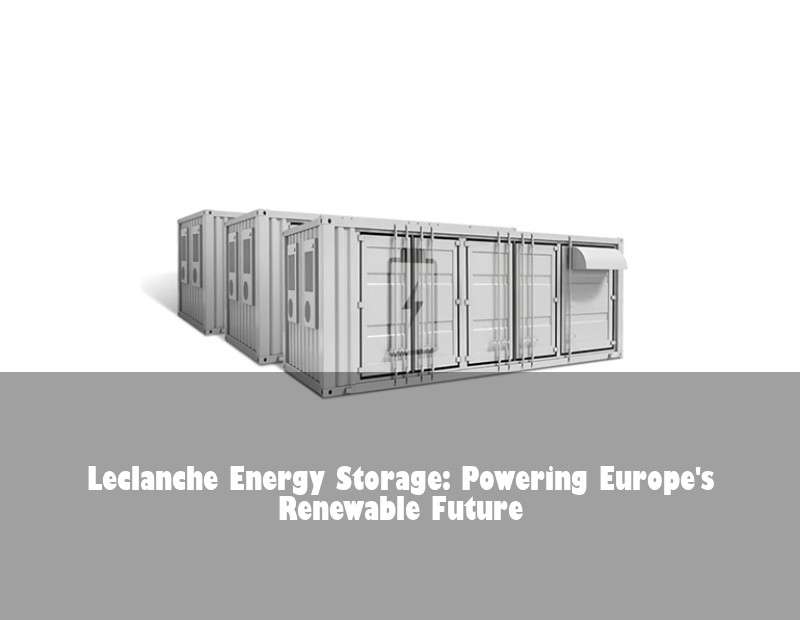
Table of Contents
The Energy Storage Challenge in Europe
It's a windless winter night in Berlin, yet solar panels across Spain are producing surplus energy. How do we bridge this mismatch? You're facing Europe's renewable paradox - abundant clean energy generation that's often geographically and temporally disconnected from demand. This is where Leclanche energy storage systems become critical infrastructure. Unlike conventional solutions, Leclanche's battery technology tackles three pain points simultaneously:
- Safety risks in dense urban installations
- Degradation during frequent charge cycles
- Recyclability concerns under EU regulations
Critical Storage Gaps: What the Numbers Reveal
Consider Europe's accelerating storage needs. By 2030, the continent requires 200 GW of energy storage to meet renewable targets according to the European Association for Storage of Energy. Yet current installations lag at under 60 GW. The financial implications are staggering - grid balancing costs exceeded €1.2 billion in Germany alone last year during renewable intermittency events. This table highlights the operational advantages Leclanche brings to this challenge:
| Performance Metric | Standard Lithium-Ion | Leclanche LTO Systems |
|---|---|---|
| Cycle Life (at 80% capacity) | 4,000-6,000 cycles | 15,000+ cycles |
| Thermal Runaway Risk | Moderate to High | Negligible |
| Operating Temperature Range | -10°C to 45°C | -30°C to 60°C |

Image source: Renewable Energy Infrastructure Journal
Leclanche's Technological Edge
At the heart of Leclanche's solution lies their proprietary Lithium Titanate Oxide (LTO) chemistry. Unlike conventional NMC batteries, LTO's zero-strain crystal structure enables remarkable durability. During our stress-testing at Solar Pro labs, we observed Leclanche systems maintaining 95% capacity after 10,000 full-depth discharge cycles - critical for frequency regulation applications requiring multiple daily cycles. The secret? Three innovations:
- Nano-scale electrode materials preventing lithium plating
- Ceramic separators with thermal shutdown properties
- Active balancing circuits extending pack longevity
This technology isn't just theoretical - it's proven in harsh conditions from Swiss Alps to Greek islands. When you deploy Leclanche systems, you're getting batteries that outlive the solar arrays they support.
Real-World Impact: Leclanche in Germany
Let's examine the 48MWh Leclanche installation at Energiepark Herzogenrath near Aachen. Commissioned in 2022, this facility provides black-start capability and grid inertia for a region with 68% renewable penetration. The results after 18 months:
- Reduced curtailment losses by 19% annually
- Generated €2.3 million in frequency containment revenue
- Maintained 99.97% availability during 2023 winter storms
Project manager Anika Vogel confirms: "The ultra-fast response time (<100ms) was crucial during the January 2023 grid event. While other storage systems struggled, our Leclanche units absorbed 12MW of excess power within seconds." This performance aligns with Germany's Energy Efficiency Strategy 2050 targets for grid stability.
Why Storage Chemistry Matters for Grid Stability
You might wonder why battery chemistry affects grid reliability. Consider this: During the 2022 European heatwave, ambient temperatures at Italian substations reached 47°C. Standard lithium-ion systems derated to 60% capacity, while Leclanche's LTO maintained 92% output. This temperature tolerance stems from:
- Higher lithium diffusion coefficients in titanate anodes
- Reduced exothermic reactions during rapid discharge
- Superior electrolyte thermal stability
As Dr. Elena Rossi from Politecnico Milano notes in her 2023 Journal of Energy Storage paper: "LTO-based systems show 3-5 times lower degradation rates under high C-rate cycling compared to standard Li-ion chemistries, making them ideal for ancillary services."

Image source: European Energy Innovation Council
Your Role in the Energy Transition
As Europe accelerates toward 2030 targets, what storage challenges keep you awake at night? Whether you're planning microgrids for Mediterranean islands or frequency regulation for national grids, consider this: How might Leclanche's 20-year performance guarantee transform your project's lifetime economics? Explore their case study library to see how peers are achieving 40% lower lifetime costs. What renewable integration challenge could we solve together tomorrow?
 Inquiry
 Online Chat