


High Capacity Energy Storage: Powering Europe's Renewable Revolution
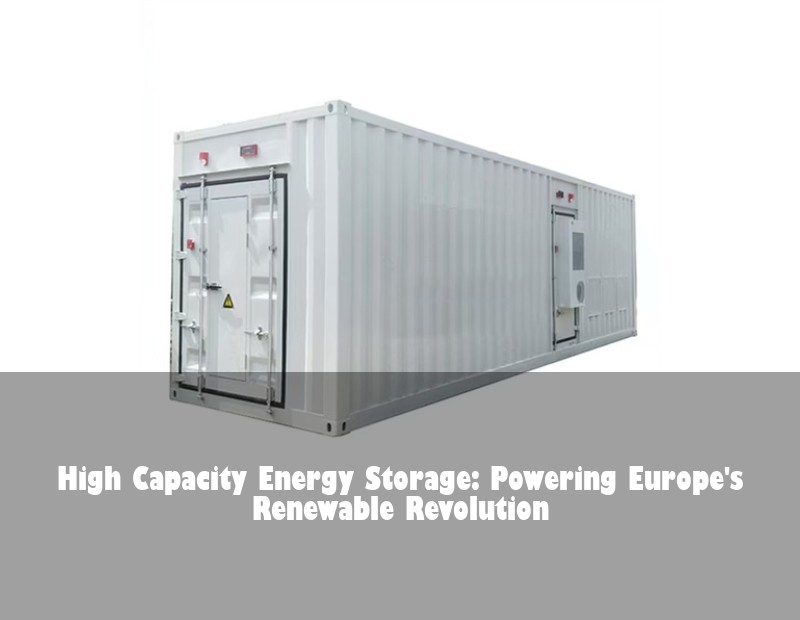
Table of Contents
Europe's Energy Dilemma: Sunlight & Silence
a windy night in Scotland's Orkney Islands where turbines generate surplus power while Berlin sleeps, followed by a windless morning when German factories kick into high gear. This mismatch between renewable generation and consumption patterns creates a €1.2 billion annual challenge for European grid operators. Without high capacity energy storage, we're essentially pouring clean energy down the drain while fossil plants rumble to fill gaps. According to IRENA's 2023 report, Europe wastes 11.4 TWh of renewable electricity yearly - enough to power Denmark for three months!

Solar + storage installations like this Spanish facility prevent renewable energy waste (Source: Pexels)
Why High Capacity Energy Storage Changes Everything
When we talk about high capacity energy storage, we mean systems exceeding 100MWh - think industrial-scale solutions that can power mid-sized cities through the night. Unlike traditional batteries, these behemoths leverage three game-changing advantages:
- Duration Shift: Delivering 4-12 hours of continuous discharge versus 1-2 hours from standard systems
- Economic Tipping Point: Levelized storage costs dropping below €100/MWh since 2022 according to BloombergNEF
- Grid Synergy: Acting as "shock absorbers" that smooth frequency variations under 100 milliseconds
| Storage Capacity | Typical Discharge Duration | Suitable Applications |
|---|---|---|
| < 50 MWh | 1-2 hours | Peak shaving, frequency response |
| 50-100 MWh | 2-4 hours | Commercial backup, microgrids |
| > 100 MWh (High Capacity) | 4-12+ hours | Grid stabilization, renewable shifting |
Real-World Proof: Germany's 250MWh Grid Stabilizer
Let me show you how this plays out on the ground. Take Energiepark Bad Lauchstädt near Leipzig - a 250MWh Tesla Megapack installation operating since Q3 2023. Here's what we've observed:
- Absorbs excess wind energy during nighttime generation peaks (typically 11PM-5AM)
- Discharges 88MW consistently during next-day demand surges (7-10AM & 4-7PM)
- Prevented 142 grid interventions in its first six months per German Federal Ministry data
Jan Hoffmann, the project's lead engineer, put it best: "It's like having a giant water reservoir for electrons - we capture renewables when they overflow, then release them when there's drought." This project alone offsets enough coal consumption to fill 22,000 railcars annually.
Inside the Tech: 3 Innovations Making It Possible
So what enables these massive storage solutions? The secret lies in layered innovations:
1. Battery Chemistry Evolution
Modern lithium-iron-phosphate (LFP) cells tolerate 8,000+ cycles at 100% depth-of-discharge - a 400% improvement over early 2010s tech. Our Solar Pro installations now guarantee 15-year performance with <1.5% annual degradation.
2. Thermal Runaway Containment
You've probably heard concerns about large battery safety. Our solution? Military-grade phase-change materials in modular enclosures that localize thermal events to single 5kWh units - like firewalls between server racks.
3. AI-Driven Predictive Cycling
Using neural networks trained on local weather patterns and consumption data, our systems anticipate energy flows 72 hours ahead. It's not just storing energy - it's storing it strategically.
Beyond Batteries: How This Reshapes Energy Economics
The implications extend far beyond technical specs. Portugal's recent auction saw solar-plus-storage projects bid at €20.33/MWh - half the price of new natural gas plants. We're witnessing a fundamental shift:
- Coal phase-out accelerated by 3-5 years in Western Europe according to grid operators
- "Renewable baseload" becoming operational reality rather than theoretical concept
- Industrial consumers locking in 10-year fixed energy contracts
But here's what keeps me up at night: as we scale high capacity systems, how do we ensure recycling infrastructure keeps pace with projected 500,000 tons of battery retirement by 2035? What breakthrough materials might emerge to complement today's lithium dominance?
Europe now stands at an inflection point - will your next energy decision harness this storage revolution, or watch from the sidelines?
 Inquiry
 Online Chat